
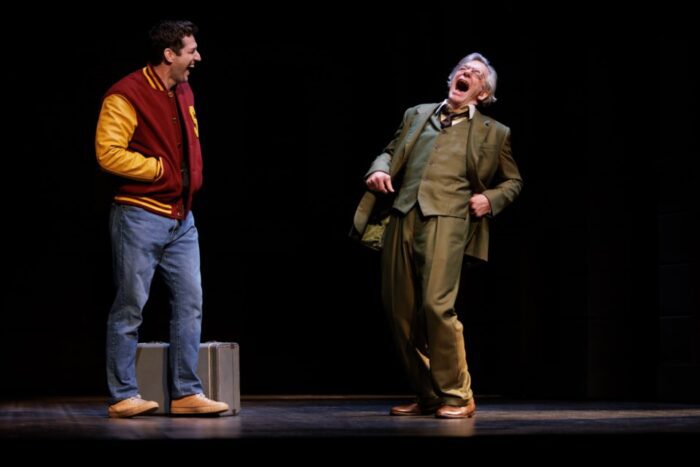
Years ago, I saw Tom McCamus in a coffee shop. I was probably in my early twenties and I’m surely not remembering it accurately but, as the encounter lives in my mind, he was wearing a leather jacker (highly improbable) and drinking straight espresso with lots of sugar (fucking iconic). What is definitely true is that he was simply sitting alone, merely existing, in a small town coffee shop and my immediate, clear as a bell reaction was “OMG, that’s Tom McCamus!”. Not out loud of course; I’m cooler than that (highly improbable). Tom McCamus is not a man you do not notice.
The casting of Stratford’s current production of Death of a Salesman is an obvious callback to their hit 2024 production of Salesman in China, in which McCamus delivered a nuanced and memorable performance as playwright Arthur Miller. I understand the temptation. Soulpepper had great success casting Diego Matamoros back to back as Molière and Tartuffe. It’s a relatable impulse to want to conflate an author with his most famous creation. But Miller was a generational genius who married Marilyn Monroe. Had I seen him in a coffee shop, I surely would have proclaimed “OMG it’s Arthur Miller!” (Again, not out loud, because super cool). Willy Loman, the titular hero of Death of a Salesman, is the definitive everyman. He’s literally used in English class to teach the concept of the everyman. His dreams of grandeur and destructive self delusion facilitate the play’s tragedy as they rest on the flimsy foundation of his “dime a dozen” reality. Willy Loman wishes he was Tom McCamus.
McCamus is a great king, a pirate, a priest, a lion. What he is not is an everyman. Even as age pulls clarity away from his signature grumble, it’s hard to imagine McCamus speaking without everyone in the room perking up to listen. He is un-overlook-able. He is therefore, in this role, some of the worst casting I’ve seen at the festival in a long time. The full ensemble of this mostly fine production of a landmark piece of writing struggles with realism, meeting the moment of Miller’s thunderous climaxes but oversaturating the perhaps more important quiet humanity. A few supporting characters fare best- Matthew Kabwe’s Charley is a prince among men and Raymond Strachan makes a promising debut in the important but tiny role of Bernard. David W Keeley is probably, for completely the wrong reasons, my favourite piece of casting as he towers over McCamus playing his remembered brother Ben, creating in a literal sense what should be metaphorically present through the whole piece- Loman’s smallness.
Dean Gabourie’s direction is straightforward, Scott Penner’s set design simple and functional, as if the creative team’s admirable focus was to get out of the way of the text. But at the end of the day, casting is the key decision that will make or break a production like this and, regardless of the prestige or skill of a great actor, not everyone is meant for every role and McCamus is too much for Loman.