
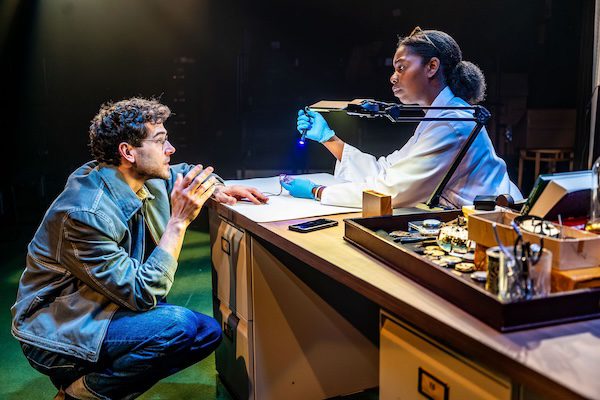
Writer/director Andrew Kushnir’s latest self-referential verbatim project presents his signature style at its complex, emotional best.
Docutheatre has a tendency to fall into reporterly coldness as the research-heavy genre often tells stories involving investigations and the dialogue is spoken exactly as originally uttered by the real life characters rather than translated through a playwright’s poetic ear. Without abandoning these conventions, Kushnir’s projects aim to humanize the hard edges by bringing the audience into the process, using himself as a character and often making the play about making the play rather than about the subject itself. In The Division, he perfects the model by embracing the unknowable, unfaceable, and messy.
For the production currently onstage in Crow’s studio space, Kushnir is played by Daniel Maslany. That extra layer of distance feels freeing for the character of Kushnir who is more at the centre of the story than ever without the play feeling too self-conscious. Maslany is a good match for the real Kushnir while avoiding impression, building the character with the external detail an actor would any role, resulting in a somehow more fleshed out portrait of our protagonist as a person not just a narrator. Presented here as a character reflected through both first person (in the writing/directing) and third person (performance) perspective, Kushnir is warm, inquisitive, and vulnerable, guiding the audience tentatively but determinedly through an emotional journey of discovery and reckoning. A frame device of a letter written speculatively to a now-six-year-old nephew to be read fifteen years in the future gives the play shape, allows for useful exposition through direct address, and lets us hear some of Kushnir’s writing amidst an otherwise verbatim recounting. He’s a beautiful writer, it’s nice to hear from him.
The four actors who accompany Maslany onstage play every other character in the story, dozens of them. Karl Ang and Ivy Charles each deliver myriad accents and character styles with remarkable flexibility and nuance. Unfortunately a common habit of verbatim befalls the other two cast members as the task of differentiating many characters without a really strong accent game leads to broader performances that don’t quite gel with the play’s overarching sincerity. Sim Suzer and Niloufar Ziaee help the performers along with a range of communicative but never archetypical costumes and a versatile set that can mostly be adjusted through swift transitions by the actors themselves (the help of a stage hand is distracting but perhaps the only truly practical option).
In some ways, The Division is very straightforward theatre. It’s clear and concise, textbook execution of its specific form and principal artist’s trademark practice. It’s also unignorably bold. In a time when simplicity is comfort and good vs. evil is default moral positioning, Kushnir’s embrace of cognitive dissonance is rebellious and refreshing. In defiance of all incentives, he hesitantly and thoughtfully punctuates a very carefully guarded reputational perfection, though he pointedly does so while avoiding easy condemnation. Perceived virtue in our brutally moralistic world can be literally life or death, and the weight of that gives The Division its movingly heavy heart. Kushnir’s belief in the value of inconvenient truth is the play’s guiding light. He receives no decisive answers and reaches no feel-good conclusions, unearthing only contradictory information, uncomfortable hints, and more questions. The frustration is a feature. The Division isn’t about exposing a fraud or righting a clear wrong, it’s about the value of looking even if there’s no way to clearly see.