
Some uncomfortably personal context: I just had a kid. Attempting to be realistic about the amount of time this website takes to run, I was planning to start maternity leave right around now and cut theatre reviewing from our coverage entirely for the rest of the year. But, when my son arrived two months early, everything currently on my desk got unceremoniously shoved aside. I’m sorry to say that this included a number of playbills for really enjoyable shows that were awaiting reviews.
Two months in, I’m realizing that I don’t have it in me to cut out theatre reviewing entirely, so I’m dipping my toe back in, slowly and with a severely reduced schedule. But before I can in any good faith write about something new, I owe it to the shows I abandoned back in April to actually publish those reviews. For fun and out of no obligation whatsoever, I’m also throwing in a couple thoughts on Musical Stage Co/Crows/Soulpepper/TO Live’s buzzy A Strange Loop, which I ill-advisedly saw in previews on my own dime literal days after major surgery (everything felt adrift and overwhelming so I dragged myself to the Baillie balcony and let some Marcus Nance bass notes ground me. We all cope differently).
So, with apologies to those who’ve been waiting, here are some much-overdue reviews:
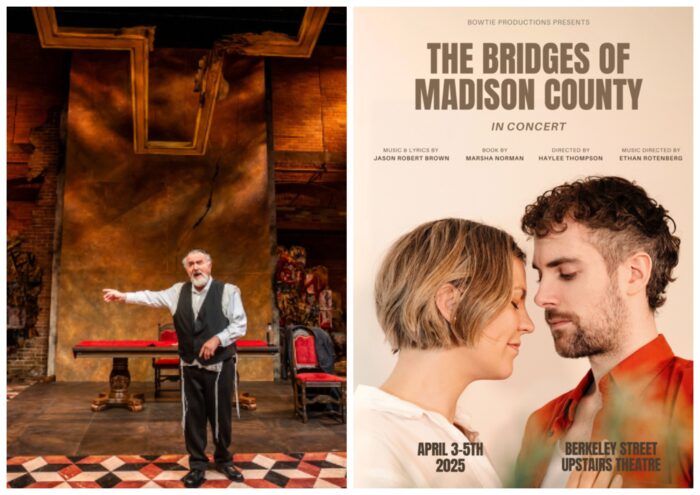
Playing Shylock (Starvox Entertainment/Canadian Stage)
A compelling and complex solo piece, Saul Rubinek’s confessional direct address plays out during what would have been the second half of a fictional production of The Merchant of Venice had the show not been cancelled during intermission. The premise uses Shakespeare’s most problematic problem play as an astute jumping off point for a personal story about identity and a political story about the impossibility of art-making in today’s political landscape. Crucially, it’s actually 2023’s political landscape as the hyper-topical play already feels slightly dated in the shadow of massively shifting realities for and about the Jewish people since the October 7th attacks. Ties to key Toronto theatre history add local interest special to this iteration of the production but Rubinek’s familiarity as a character actor from the past few decades of American TV and film gives the work universal appeal (a very well-timed Frasier rewatch worked out particularly well in my favour). Rubinek is a captivating performer who is able to pull his audience through despite the occasional dramaturgical pitfall and the work remains hard, important, and relevant even as a revised, even more complicated draft may become necessary.
The Bridges of Madison County in Concert (Bowtie Productions)
Bowtie Productions’ latest project showcases the company’s trademark confidence but pulls back on the bells and whistles as it presents Jason Robert Brown’s challenging adaptation of The Bridges of Madison County in concert form. The overall strong ensemble handles the tricky score generally well despite the occasional moment of high-stakes struggle (the climactic “It All Fades Away” is a little beyond the scope of Taylor Long’s gentle voice but he sounds beautiful across the rest of the piece). The band, however, struggles pretty consistently with the demanding orchestrations. Without strong chemistry in the central romance, it’s the supporting characters who unexpectedly shine here with standout performances from Chantalyne Beausoleil and Fynn Cuthbert as well as Thomas Fournier as Francesca’s clueless husband. The story of Bridges is somewhat off-putting, a simplistic and awkwardly sexualized romance for bored housewives to dream about without any grounding in recognizable behaviour, and as such the adaptation of an adaptation of a book published in 1992 feels really dated. There are some pretty songs, and I appreciate Bowtie choosing a rarely produced but demanding piece to showcase the company’s excellent vocalists, but this work is definitely best left in concert form because the storytelling can’t support much more.
The Fostered Playwrights Festival (Foster Festival)
Back in the spring I was honoured to get to attend the Foster Festival’s annual weekend of staged readings of developing work. A hidden gem of a repertory company in the Niagara region, The Foster Festival focuses on its prolific namesake’s work but acknowledges that its future (and the future of the larger landscape) will be brighter if time and resources are put towards, ahem, fostering the next Norm Foster in addition to celebrating the current one. Hence, the Fostered Playwrights Festival. A brilliant idea with its heart very much in the right place, the festival gives up-and-coming playwrights a chance to have their work developed with the help of Artistic Associate Jamie Williams then briefly workshopped and presented onstage featuring actors of impressive calibre (I’ll admit that the festival caught my eye almost entirely because Gray Powell was going to be doing one of the readings). Over the course of three days, we saw three plays of widely varying quality- a range that suggests both the selection process and the dramaturgical development aspect of the program could use some shoring up. The audience feedback portion of the weekend also doesn’t seem like it’d be all that actually helpful for the playwrights but I hope the performers are able to honestly engage a bit in order to strengthen the work on its way to a full production in the future. Only in its second season, the playwrights festival is a wonderful addition to the Foster Festival programming and a smart way to test drive future productions. With a bit more rigour and candor, this festival could be an important stepping stone for the future of Canadian playwriting.
A Strange Loop (Musical Stage Company/Crow’s/Soulpepper/TO Live)
I don’t actually have all that much to add to the conversation around this much-anticipated production of a Tony-winning but not too-famous text. I didn’t think the lead was strong enough for such a star-dependent piece and the direction wasn’t all that interesting. What made this work worth writing about (despite a no-invite-no-review policy that I really do try to stick to) is that ensemble. Holy moly what an ensemble. Playing the myriad voices in Usher’s head playfully with no thought to casting type or consistency, the combo of Sierra Holder, Nathanael Judah, Marcus Nance, David Andrew Reid, Amaka Umeh, and Charlie Clark (in for Matt Nethersole at this performance) totally took over the show and each brought incredible range and killer vocals. But what stuck in my head the most weeks after A Strange Loop was Amaka Umeh, one of Canadian theatre’s biggest stars whom it’s rare (nay, unheard of) to see in a chorus role. The reason for that is that it’s impossible to tear your eyes away from them, making focusing on the lead character feel a bit like a chore. Well-rounded and uniformly talented, Umeh’s been well-praised already on this site and every other but I just wanted to do it again, at least briefly. Notable for their limitless casting potential that unlocks characters across the full gender spectrum, a range of ages, and within mediums from musical to classical to intimate modern drama, there’s very little Umeh can’t do and they do it all with a level of intensity unmatched in Canadian theatre. In a profession that too many treat like a hobby, for every performance in every context, Umeh shows up to work. What a gift to have them on this scene.