
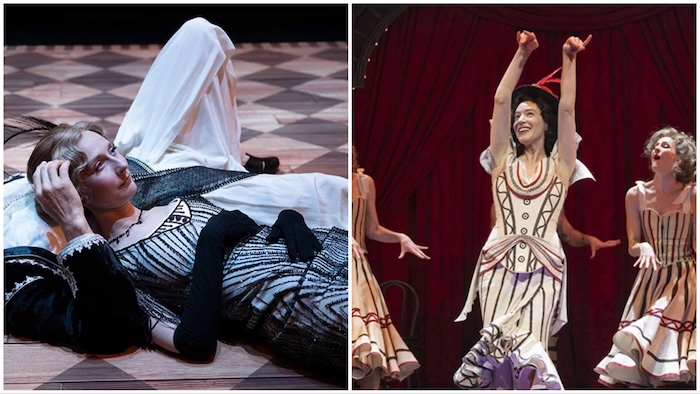
Two of the strongest productions at the Shaw Festival this year, this duo of dramedies features witty, vibrant women and the flimsy men who take up too much of their time.
Among women who can seriously sing in Canada, to the best of my expertise, Sara Farb is probably the best actress. That’s a front and centre reality of her performance as Fanny Brice in the musical Funny Girl, a role usually played with great focus on bombastic vocals, which she instead performs with understated sincerity and thoughtfully deployed goofiness. Her Fanny isn’t constantly in “funny girl” mode but rather hides behind silly faces when overwhelmed or unsure. She’s hyperactive, insecure, and relentless- qualities Farb is able to transition beautifully as the character matures. She’s not a singer whose big notes rattle the audience’s heart but rather a skilled vocal technician able to hit the notes while performing the moment first and foremost. It’s a different kind of impact, and not what everyone is looking for or certainly expecting from a Funny Girl, but it’s as theatrically legitimate and emotionally compelling as anything.
The story of Funny Girl is a frustrating one wherein this big bright woman makes herself quite small for a man who bowls her over, only stepping out of that circumstance at the very last moment. As said ruinous man, Qasim Khan is an odd choice. He’s smooth enough but he’s also terribly sincere, which confuses the story and gives the character a vulnerability that detracts from the mysterious air that makes Fanny so fatally starstruck. On the flip side, wielding far more sense-making sincerity, there’s a great role for Matt Alfano as one of Fanny’s truest supporters. One of the country’s strongest physical performers, it’s rare that Alfano gets to speak much onstage let alone develop a full character. As the role of Eddie Ryan demands standout tap skills, it’s a treat to get to see him show off not only his primary skillset but also some of his other triple threat abilities.
Something both of these shows share is lush period design and straightforward direction that keeps the focus on the performances. Heartbreak House in the studio theatre is particularly fleet of foot, especially considering the text has a tendency to drag with its three-act structure (even at a good clip, though, I’d advocate for at least a short pause between acts two and three).
The full ensemble is as strong as they come, showcasing the bench depth of seasoned GBS specialists on the more established end of the Shaw’s acting pool. At the heart of the production is a pair of well-matched sisters in Sochi Fried and Julia Course, two striking performers whose grounded elegance is particularly well deployed here.
Course, of course, is particularly sublime as witty heiress Hesione, something I find myself writing at least once seemingly every Shaw season. She’s bright and effortless, striking the lowest of blows with the highest of spirits and eating up the stage as a woman capable of winning the world but stuck with just an odd old house and a silly husband to make the most of (her husband is Martin Happer, in fine form right at the centre of his hit). Should the bantery philosophy of the Shawiest of Shaw texts start to bore, Course is beautifully deliberate with her physicality and a whole other play’s worth of relationship context is provided in the microcosms of her interactions with every other actor.
I was surprised at how much I enjoyed both of these productions, hampered by texts I’d never before been particularly fond of. But casting is truly 90% of the battle and the women at the heart of these productions breathe such incredible stardom into their roles that they become irresistible.