
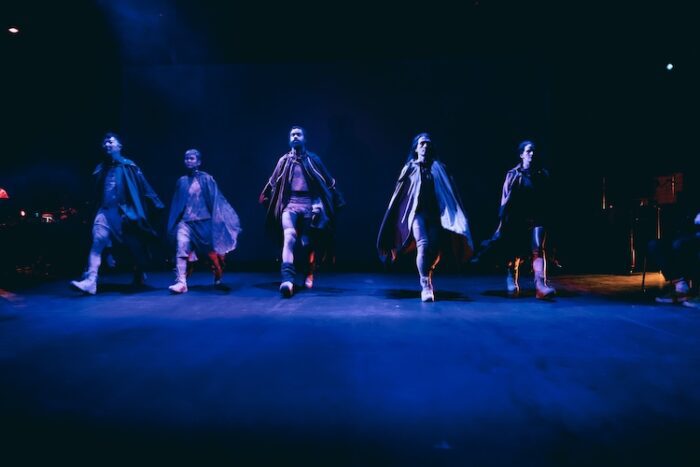
It Could Still Happen is a company that grounds itself in such values as exploration, embodiment, and taking one’s time during a creative process. And so it’s not a surprise that The Herald still has a work-in-progress vibe as it begins with writer and director Jill Connell emerging, carrying their own podium amidst a fog effect, to give a lecture-style monologue.
Connell’s writing has clear flair from the start: at times poignant, at other times absurd. They praise the bravery of whimsy in a world that values utility and capital gains, distraught by the thought that their astrological daychart has doomeed them to flourish in the 9 to 5. They long instead to have a nightchart, like Antonio Banderas, speculating this as the source of his artistic whimsy, the kind that made him romantically declare that he wanted to bring back capes. Capes are, after all, delightful despite (because of?) their lack of obvious utility. Capes are cool, like Antonio Banderas. This, of course, captures the main theme of the play, which is about how to think outside of a society that bifurcates capital and care.
After Connell’s monologue, we transition to the story of Herakles, who occasionally pops in between the twelve labours (treated like an exhausting To Do List) while the Herald spends much of the time waiting for Herakles, all the while toiling away on a single cape. When Herakles muses that they might instead join Jason and the Argonauts after they’re done, the Herald nearly loses it (I particularly loved a mini mock-commercial for Jason and the Argonauts projected onto the back screen that offers a good lesson to Pete Hegseth in how to make bellicose masculinity sexy again). How can any of us be with someone whose identity is so wrapped up in their job?
The writing is serious without taking itself seriously, which is exactly why it’s so effective. The cast has excellent chemistry and spot-on deadpan delivery, and the performances are strong aside from some spotty vocal projection. The costume material is an absurd facsimile of the idea of a godlike fabric, although under a certain light it looks distractingly cheap rather than ephemeral. The transitions between the different elements (initial monologue, main storyline, and final choral piece) could be better finessed for clarity and overall cohesion. But these are mostly minor complaints. The piece is borne from curiosity and delight, and it would take work not to be charmed.