
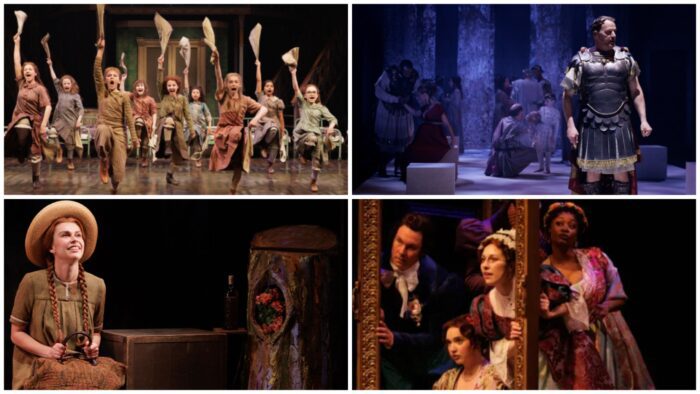
I try to review the full Stratford season every year and, with very few exceptions, have done so with great consistency since 2010 (I missed the 2022 late openers and I think a Henry VIII at some point?). This year I’m supposed to be on maternity leave but the thought of missing out completely just felt wrong. The Stratford Festival is such a foundational part of any Ontario theatre-goer’s life that skipping it means more than just missing a few plays. I have traditions built up around the festival, institutional knowledge, absurd para-social attachment to performers I saw for the first time when I was six years old on that very same stage. The idea of missing my annual trip with my best friend, or not taking my mother to see Annie– I just couldn’t do it.
So I saw five things. Not even quite half the season but not nothing either. I have a sneaky suspicion that I left the best of the season on the table, a forever mystery that I may always regret (last year I never would have prioritized seeing The Diviners but I think about that show all the time). I’ve already written about my most anticipated show of the year As You Like It but here are my thoughts on the rest of what I was able to see:
Sense & Sensibility
This charming but slow Jane Austen adaptation attempts a few different techniques to help theatricalize the novel’s somewhat subdued storytelling. A little troupe of “gossips” form the community around the characters (and, troublingly, also play a host of animals who appear briefly in the story) while also adding a touch of framing narration as Austen’s memorable third person is lost to the new medium: a smart idea but cloying in execution. Literal frames also make an appearance, nodding at the opulence of the settings without the full production values to match and tossing some metaphorical meat at any field trippers who need something to put in their essay about the show. Aggressive double casting is perhaps the most effective of these directorial gimmicks, purposefully linking and/or contrasting certain supporting roles and giving unexpected performers the opportunity to show off a wider range of skills. Thomas Duplessie particularly makes the most of this effect, proving his romantic lead chops as Edward then dramatically turning off the charm to play his brother Robert. More subtly, Andrew Chown settles so completely into the roles of both Johns Dashwood and Willoughby that it took me far too long to realize he was in fact doubling at all. The size of the festival theatre and grand style of Stratford in general ultimately feels ill-suited to this story that’s in some ways defined by being, at most, Austen’s second most popular. Arguably the two most loveable characters, Elinor Dashwood and Colonel Brandon, are notable for their reserved natures, something that’s extremely hard to show in this kind of setting. The novel beautifully insists that a quiet feeling is no less valid than one proclaimed with poetry but here the quiet feelings are just, well, a bit too quiet in a production that is trying too hard to fill the space and make a splash.
Winter’s Tale
Unfortunately it looks like I won’t make it to Robert LePage’s biker gang Macbeth before closing but it’s quite obviously, at least aesthetically, a big swing. As is Chris Abraham’s As You Like It, which also modernizes and boldly adapts. Strong choices and modern (or inventive) settings are a directorial practice of which I wholly approve when it comes to Shakespeare, whether the case by case results work for me or not. But I also very firmly believe in balance in a repertory setting so this very by-the-book Winter’s Tale directed by Artistic Director Antoni Cimolino is an excellent contrasting piece to the overall season programming. Graham Abbey is a grand Leontes, his good-natured charm (and winning ease with the young actor playing his son) adding “he’s not usually like this!” ache to act one while his traditional masculinity gives the horror a telling hint of “isn’t he, though?” that goes a long way to make the king’s strange behaviour feel systemic and thus a bit more relatable. The rest of the cast sort of fades to the background (an unfortunate thing for a play that abandons its leading man for endless middle-act hijinks) save Marissa Orjalo whose Perdita leaps off the stage with sparkle and depth beyond the little the text gives her. This Winter’s Tale will likely not embed itself in memory the way some of the wilder interpretations can, such is the plight of the straight shot production of the year, but in a repertory setting there’s so much to be said for solid, steady work with a highlight or two on one of the smaller stages and this is a perfect example of just that.
Anne of Green Gables
A must-see on my limited list this season, my longstanding love of Kat Sandler and my even longer standing love of Anne of Green Gables come together in this adaptation that simmers along expectedly but charmingly until the biggest of big swings sends act two careening into very strong “love it or leave it” territory. Personally I could have lived without the twist, ironically thinking throughout act one how special it was that Anne of Green Gables’ universality could make the modern young audience feel seen and engaged while watching something so removed from their own setting. Sandler’s direction of act one is swift and energetic but practical and unflashy, keeping the focus on the characters and demanding that the young audience dial in without the help of too much production pizzazz (production pizzazz is so often a pitfall of Stratford’s underwhelming children’s programming). Sarah Dodd and Tim Campbell are wonderful as Marilla and Matthew, summoning the familiar warmth of the characters but making them their own (Dodd adds just a touch of welcome spice to her eye-rolling Marilla). Most notably, Caroline Toal makes the jump to Stratford alongside her longtime collaborator Sandler. Somewhat of a specialist in playing kid characters as an adult, the small and bright-eyed Toal is a wonderfully wild Anne, bouncing off the walls but never pushing the childishness too hard as a character forced to grow up too fast. It’s a great performance anchoring an adaptation that left me with mixed feelings. I see why making big choices with a beloved and oft-revisited text could feel like a good idea, and I’m trying to make sure my reaction isn’t tied to knee-jerk protective instincts, but something feels pander-y to me about that second half, updating for the sake of updating with a touch of holding the audience’s hand and maybe even a gesture at fixing something I’m not sure needed fixing.
Annie
Probably the best bet of the season, this Donna Feore-directed blockbuster was always going to be a hit with classic songs, a few pieces of surefire casting, and Feore’s trademark precise execution. Pragmatic and exacting, Feore is second to none when it comes to staging big dance numbers that make the production seem massive. Here she uses a tiered system that highlights her best dancers (including Devon Michael Brown, the Stratford musical company’s not-so-secret weapon) with ambitious, acrobatic choreography and fills out the rest of the stage with every body available doing more pared down sequences so even the “strong movers” seem like they’re star hoofers. The chorus of kids cast for this production are genuinely star triple treats with killer vocals and incredible dance skills. No one works harder than a little girl in musical theatre and the accuracy and energy on display in all of their numbers but especially the crucial tone-setter “Hard-Knock Life” sends the production off on the strongest of footing. I was less taken with the leading lady whose excellent vocals seem to have been the casting priority. She gives the kind of dependable performance that surely feels safer for a production team putting the weight of their flagship production on a kid’s shoulders but ultimately feels very wooden. The adults bring the energy back up, however, as Dan Chameroy’s alpha dad energy is put to excellent use as Warbucks (I personally think he should have shaved his head but I understand that that’s unnecessary fealty to iconography) and Jennifer Rider-Shaw is a steadfast Grace with lovely vocals. Laura Condlln continues to thrive in her “brassy villain with secret sadness” era (see also Captain Hook) and Mark Uhre builds on last season’s momentum as a show-stealing Rooster full of unabashed verve and gross ambition. A more relaxed lead would have put it over the top but it’s hard to argue with a production this perfectly executed. It’s the Feore effect, nearly peerless.