
Critic’s Note: The performance reviewed was the June 12th preview.
Experimental writing and the plays that come with it is tough. The art of saying something while sometimes saying nothing. The art of nothing happening but saying a lot in that nothing. Samuel Beckett made a career of it; Seinfeld ran on it. It is a delicate balance that, when done right, can be profound and challenge narrative practices and assumptions. However, when this balance is not executed effectively, it can result in a piece that feels like it is unsure of what it wants to say while at the same time saying a lot that just doesn’t quite gel. Unfortunately, that is where You Must Change Your Life falls.
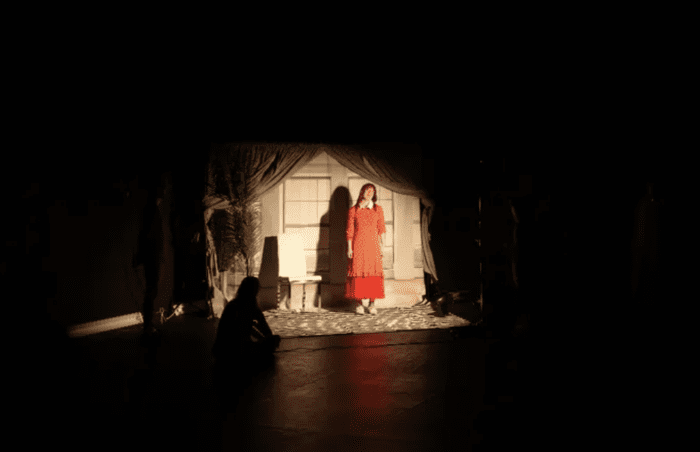
That is not to say that the show does not really give it an admirable try. Taking text from the notebooks of Richard Foreman, creator and director Ilana Khanin starts off the piece strong and clearly has a passion for the text. Kicking off with our two characters played by Annie Hoeg and Thea Mae Hesler, the audience is treated to a Waiting For Godot-esque dynamic that hints at a deep personal relationship and history in their youth as they muse about stories and theatre and whether things have a point. These two have a good chemistry together and the directorial movement choices give them more to chew on than just dialogue.
Their story is set on a barebones stage with even the backstage and production equipment able to be glimpsed by the sides, the ensemble dressed in variations of theatre blacks while also playing the role of stagehands. There are attempts made at addressing the different elements of theatrical storytelling, but the goal of this meta journey just falls flat. The text veers into too random, too vague, too much like a comedic set up with no punchline in sight or a throughline to follow. It also does not help that the interesting directorial movement choices made in the first bit with just Hoeg and Hesler on stage don’t really come back and now must contend with an ensemble that isn’t given much to do. This eventually displays a piece that also feels quite monotone and unclear without much changing or challenging.
A New York experimental theatre artist, Richard Foreman’s work was known for constant change and reinvention day in and day out throughout the creative and rehearsal process. An artist whose textual work has been described as stray thoughts or, as one article said, “a mystic had fallen through the looking glass, or a philosopher had become stuck in a screwball comedy.” While there is evidence of this influence in the text of You Must Change Your Life it also still feels like it is only scratching the surface of what could be found and feels like it has not found its own voice yet.
This is a piece that can grow into something that does confront and play with the narratives of theatre. Something that challenges what an artist can do and the entire creative process. But it first needs a stronger structure, not rigid, still flexible but one that can give a malleable throughline that benefits from the constant movement of text inspired by Foreman. Most importantly it needs a clear voice. There is potential in this show, but You Must Change Your Life has some changes to make.