
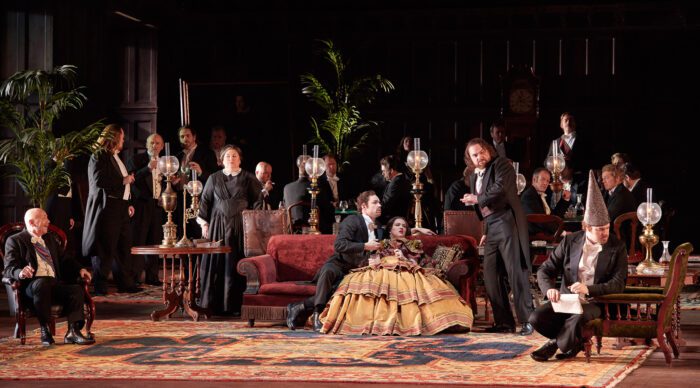
This production has had ample time to mature. It marks director Christopher Alden’s second revival of Rigoletto for the COC (2011, 2018) and the original staging dates back to the Lyric Opera of Chicago (2000). Yet there’s little evidence it has evolved in any major way. It makes no effort to engage with the sociopolitical reckoning that has unfolded since #MeToo or the exposure of Epstein’s abuses. In a cultural moment where period dramas like Downton Abbey examine class and power, and even glossy escapism like Bridgerton flirts with critique, this Rigoletto resists interrogation. It presents the misogyny of its world as-is and expects the audience to accept it on those terms.
Fortunately, the production is buoyed by an accomplished cast. Gilda, the ill-fated daughter, is a demanding role requiring vocal athleticism and dramatic nuance. The part calls for lightness and agility to vault above Giuseppe Verdi’s orchestration (libretto by Francesco Maria Piave), yet depth enough to anchor its emotional weight. Sarah Dufresne delivers both. Her performance is precise, intentional, and vocally fearless – a powerhouse whose clarity of line and purpose rarely falters. This was my first Rigoletto, but it is difficult to imagine the role sung more convincingly.
Quinn Kelsey in the title role matches her intensity with a voice that is full-bodied, sonorous, and technically assured. His portrayal leans toward severity – possessive rather than tender – emphasizing control over compassion. Peixin Chen’s brooding Sparafucile and Zoie Reams’s captivating Maddalena round out a compelling underworld duo. Stephen Hegedus (Count Ceprano) and Gregory Dahl (Count Monterone) bring admirable earnestness to their confrontations with the predatory Duke of Mantua (Ben Bliss) and Rigoletto, respectively.
Bliss, however, fails to fully sell the Duke’s carnal appetite. The role demands reckless magnetism but here feels polite. His infatuation with Gilda appears unexpected rather than inevitable. More generally, the production’s pacing often sees urgency evaporate when we least expect it, exemplified by a scene in which Rigoletto slowly drags Gilda along upstage, stirred only by their reaction to oncoming storm cues.
Visually, the production fares far better. Duane Schuler and Mikael Kangas’s lighting design is a clear triumph: naturalistic shafts of light cleaving through the Victorian darkness beautifully. These moments evoke the chiaroscuro of Renaissance and Baroque painting, beauty emerging from shadow, reflecting the libretto’s polished yet morally compromised world. Michael Levine and Charlotte Dean’s set delivers a richly atmospheric backdrop: wood paneling rising from floor to ceiling, tapestry-lined ceilings, and the glow of brass gas lamps create an aristocratic decadence that is both elegant and oppressive. Their costumes are equally meticulous, from the opulent gowns to sharply tailored court attire.
Despite the abundance of entrances, exits, and playing spaces, the fluid blending of locations – gentlemen’s club, court, home – often muddies logic. As a result, transitions feel dreamlike, leaving the viewer uncertain whether they are conceptual or accidental. The ambiguity extends to staging details. First, Alden introduces a curious invention: a dancer, likely Monterone’s dishonored daughter, who spins madly through the Duke’s court in a white chemise. Sometimes attended to and sometimes invisible, she hovers like a prophetic ghost. Next, Giovanna (Simona Genga)- who doubles as Rigoletto’s maid and the Duke of Mantua’s procuress in the libretto itself- is so omnipresent in this production it becomes disorienting. Finally, a cursed Rigoletto frequently projects aimlessly on the fringes, or while gazing into the void from his armchair – an effective image that loses clarity when paired with inconsistent scrim use. At times solid, at times transparent, and occasionally rippling under front light, the effect distracts more than it reveals. By contrast, small symbolic touches, such as Gilda traversing a rolled carpet standing in for an alley, are evocative and sorely underused. More visual conventions like this could clarify the production’s geography. All in all, sharper transitions and tighter blocking could restore tension and focus.
The final act benefits from the eerie offstage chorus whose distant resonance amplifies the gathering storm and looming tragedy. While onstage, the COC chorus is consistently excellent too. Guiding it all is conductor Johannes Debus whose musical leadership ensures the evening’s lasting impact. Whatever the staging’s conceptual hesitations, Verdi’s score prevails. We leave with the grief of a father, the wreckage of hollow relationships — and melodies that linger in the mind long after the curtain falls.