
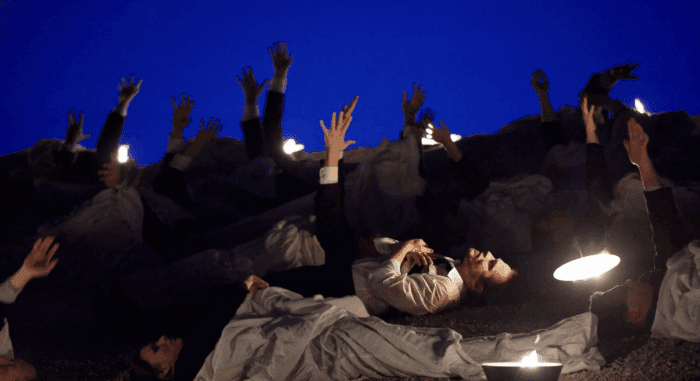
When we watch Christoph Willibald Gluck’s Orfeo ed Euridice at the Canadian Opera Company, we are offered more than a simple narrative — we’re invited into a space of ritual and reflection. Christophe Gayral’s staging (originally conceived by Robert Carsen in 2011) evokes how I imagine an ancient Greek tragedy performed: stripped of excess, yet profoundly moving in its simplicity. The story and music reach the heart directly, without the distraction of superfluous spectacle. Still, Thanatos and Eros meet vividly here, their tension creating moments of true magic.
The production opens with a slow, haunting funeral procession — a striking prelude that establishes the atmosphere for what follows. Tobias Hoheisel’s set is fully and artfully used; no corner or stone remains untouched. One of the most memorable images is that of the chorus of Furies: lifeless yet suddenly animate, rolling onto their sides, eyes wide open, confronting both Orfeo (Iestyn Davies) and the audience as he enters the underworld.
There are, however, a few moments where stillness works against the drama. When Amore (Catherine St-Arnaud) instructs Orfeo on the conditions to retrieve Euridice (Anna-Sophie Neher), he remains a frozen statue over her grave. This isn’t the only time. While tableaux can heighten an emotional plot point, the scene might have benefitted more from allowing Orfeo to listen more actively, rather than become a statue within the story. Further, spatial levels in these moments which can add visual interest to the mise-en-scène are avoided, perhaps intentionally echoing the opera’s stripped-down journey.
One of the production’s quiet triumphs lies in its lighting design (Carsen and Peter Van Praet). The transitions are so seamless they’re nearly imperceptible — we feel shifts in time and place rather than consciously noticing them. And what a thrill to witness so much real fire on stage: rows of flame-filled bowls illuminate the infernal world below and mirror Orfeo’s consuming passion (it’s worth checking out the COC props department’s YouTube video on the neat invention ensuring safety protocol).
While the pacing in Act II lingers a touch too long, patience is rewarded with the emotional centerpiece of Act III — “Che farò senza Euridice”. Here, Orfeo’s grief unfolds with aching sincerity as he mourns his failure and loss. It’s also a joy to finally hear more of Canadian soprano Neher, whose Euridice captures both the anguish of (perceived) rejection and the radiant relief of being granted life once more. The musical precision of Catherine St-Arnaud, together with the chorus, and the orchestra under Bernard Labadie’s direction, is undoubtedly immaculate — a true highlight of the evening for me. As the God of Love, Amore walks the fine line between celestial grace and impish mischief. I couldn’t help but long for a bit more playfulness — a glimmer of that Puck-like spirit to enliven the role and lift the weight of the production’s solemn tone.
The colourlessness in this piece might not be to everyone’s taste. But in a world saturated with conflict and disconnection, Gluck’s opera offers a rare glimmer of hope — a belief in love’s endurance and the redemptive power of compassion. As Carsen himself notes: “Orfeo fails, but he fails for the same reason he deserves to succeed: for love. And that is why, in spite of his failure, Amore appears to him again and rewards him a second time.”
Perhaps that’s the opera’s truest message: love is imperfect, communication falters, and yet grace still finds us. We must go out, make mistakes, and love again — for we never know what reward might follow.