
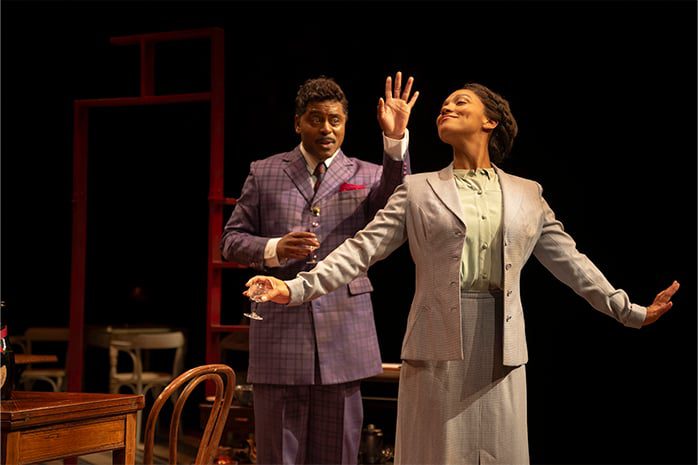
The performance I attended of The Shaw Festival’s Blues for an Alabama Sky was one of those nights at the theatre that makes theatre-going endlessly exciting but also somewhat hard to review. With presumably very little notice, understudy Kiera Sangster was in for the leading role of Angel Allen (usually played by the brilliant Virgilia Griffith). A longtime member of the musical company, Sangster is one of those rep company gems who manages to make a big impression in small role after small role but never seems to get much to do. Here, under rehearsed to the point of needing her script in her hand (a product I assume of this being a late opener? Though I might argue understudies should be as ready for the first preview as the main actors, impractical though that demand may be), it was a thrill to get to see an actor deliver far beyond what’s usually asked of them. I’ve covered Griffith for years, I’m fairly certain I know what her performance in this role would have been like (and I am admittedly sorry to have missed that), but it’s a quintessentially theatrical moment to see an understudy thrust into the spotlight and I always consider that a privilege.
That said, because she was an understudy, and as unprepared as I’ve ever seen one (most actors who bring the book do so purely as a safety mechanism, there were moments here that felt much closer to a cold read), there isn’t much I can critique about the leading performance at this particular performance other than to say that Sangster is, as always, a deeply likeable presence and I’d love to see her get to do more contemporary non-musical work.
What I can weigh in on is the rest of the production, which is as steadfastly effective as can be. Directed by Associate Artistic Director Kimberley Rampersad, this perfectly cast drama showcases a compelling narrative centering Black characters within the Shaw’s limiting mandate (written in 1995 but set in 1930, this programming is a testament to the incredibly useful and relatively recent expansion allowing for modern plays written about the time period of Shaw’s life, not just plays technically written during that time). For a long time, the mandate was an excuse to overlook stories about Black people and other people of colour but the consistency with which these twentieth century tales have been the highlights of recent seasons speaks volumes about the quality of the texts available if you prioritize finding them. This script by Pearl Cleage lacks a bit of forward momentum (to be fair, pace is the first thing to falter when an understudy comes in) but it features richly drawn characters it’s impossible not to tie your heart to. The cast mostly comes from the musical company and they all make the transition excellently to the smaller style of an intimate studio piece. Anything Goes leading lady Mary Antonini skillfully dims her dazzle to believably play second fiddle while Stewart Adam McKensy hides tenderness and hurt beneath the shiniest of veneers. The incomparable Allan Louis is smooth as silk, a quality for which he is unmatched in Canadian theatre.
Shaw’s bread and butter is strongly acted modern drama (or comedy) with detailed design and thoughtful but understated directorial work. Blues for an Alabama Sky doesn’t make many waves (assuming you don’t seen an understudy) but it delivers exactly what the company does best and makes a fantastic argument for the continued value and expansion of this type of work.