
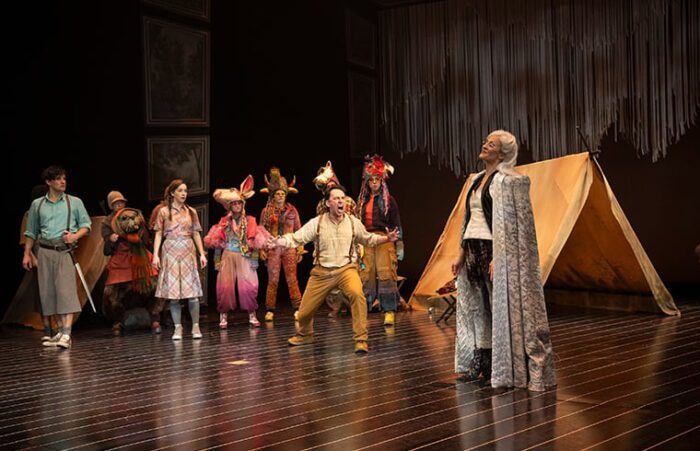
This much-maligned production I think gets a bad rap that’s only partially deserved. There’s a lot that it gets right, it’s just that what it gets wrong it gets very wrong and those things are super distracting (and unhelpfully weighted towards the end, making them more memorable).
I’ve long been a fan of the Shaw’s generally straightforward approach to children’s programming. Unlike another major company that consistently coats their kids stuff in glitter and neon as if to imply that’s the only way to keep kids’ attention, the Shaw usually embraces the same grounded maturity that marks much of their work when dealing with the kid stuff- from the strictly period adaptation of The Secret Garden that showed the same literary respect to the source material as is given to adult work of the same period to their classic production of A Christmas Carol that relies solely on practical theatre magic for its showstopping effects. The simplicity of the effects in this trip to Narnia at first seem to participate in this tradition. Puppet animals and moving setpieces pair with mandatory imagination to build the complicated (and iconic) world of the play. The big (or, perhaps, small) swing of the Aslan costuming is a fan least-favourite decision (especially after the absolute thrill of the Caspian version) but I can at least appreciate the grounded concept behind the idea. But there’s a strange halfway-ness to the design aesthetic here, as though no one had quite enough faith in the low-fi approach when dealing with such fantastical material. The sets and costumes in the Narnia section are bright and cheap-looking, covered in sparkles and streamers like an ill-conceived birthday party. This effect gets worse as the play goes on and peaks with the appearance of someone called the Spirit of Narnia, a deeply cheesy invention seemingly created with the sole purpose of over-explaining the themes of the play.
The Spirit of Narnia also embodies the show’s principal sin of being a half-musical. There are just enough musical numbers to break the seal of audience expectation but not nearly enough to be satisfyingly a proper musical. There’s a lot of buy-in and suspension of disbelief involved with a musical so to toy with being one and never quite commit is irritating for an audience unsure of how to calibrate for tone. What’s worse is that the songs are actively terrible, none more so than the surreal final number that’s so cheesy it literally reminded me of the goodbye song on Norwegian Cruises. The argument for simply cutting the songs is so strong it’s baffling that no one seems to have made it. The lack of commitment to either breaking or respecting the fourth wall is less but still notably irritating.
There is good news, however, and that mostly comes on the casting front. Michael Therriault as Tumnus is one of the most obvious pieces of casting I’ve ever seen, which I absolutely mean in a good way. His natural warmth and impish joy are so well-suited to the role that I felt certain I’d seen him play it before (but I think I actually just think of him every time I see the character). Similarly, Élodie Gillett was born to play the Witch Witch. Cold, sharp, a little goofy, and fabulous in her terribly chic costume, the only way to improve her take on the character is to put her in higher heels (or give her her famous carriage? Why is she just walking around on everyone’s level?). I understand the impulse to cast Jeff Irving and Kristi Frank as kids, and they’re as charming as ever, but their childlike wonder backfires a bit as characters who are meant to be old before their time.
If I pretend that final number never happened, this version of Narnia ends up in some middle ground- not as good as most of the Shaw’s kids programming (especially in the shadow of 2023’s Prince Caspian, which I loved), but better than most of Stratford’s. But that final number did happen, no matter how hard I try to forget it, and we all just have to live with that. May the Spirit of Narnia forgive us all.