
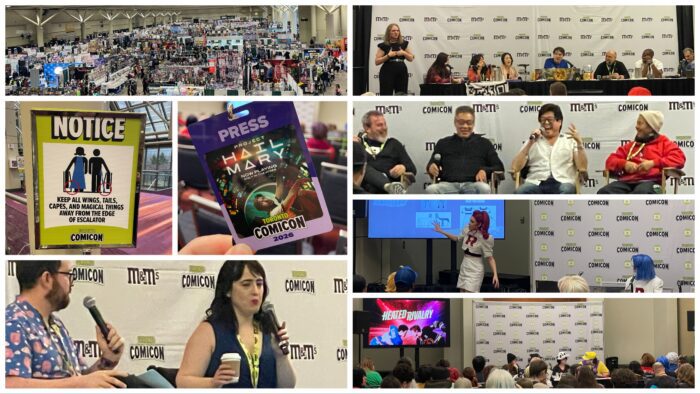
Last weekend was Toronto’s annual Comicon.
I say annual but it’s really bi-annual as FanExpo, the company that runs the event, runs another weekend (appropriately titled “FanExpo”), also at the Metro Toronto Convention Centre, that resembles Comicon in nearly every way except that it’s about three times the size (45,000 attendees vs 135,000, roughly). That event will happen in August and, though very few of the programming and guest details are online at this point, it’s already confirmed to have all four hobbits in attendance. Toronto Comicon is very much not the one with the hobbits, for worse (of course, because no hobbits) but also in some ways for better.
Most of my con experience comes from covering San Diego so I’m used to a very promotion-heavy, celebrity-focused experience (or, rather, I’m used to hiding from the crowds on the press floor of the Hilton next to the convention centre). But neither Toronto event is big enough to be used as much of a launching pad. The result is a lot less star power but more of a genuine fan-centric experience. The celebrities that are there tend to be lesser-known and/or fondly remembered rather than going concerns so, rather than anticipating tidbits about upcoming projects, attendees focus on nostalgia and getting to interact with performers who were important to them as kids. This year’s Comicon had multiple events celebrating the 90s live action Ninja Turtles movies (which had some of the most interesting behind the scenes info I’ve heard- there were four performers for every Turtle!) and a conversation with Matilda herself Mara Wilson. While San Diego provides the opportunity to breathe the same air as some of the most famous people on the planet (OMG it’s RDJ!), Toronto Comicon’s more human-sized stars are there not for everyone but for the people who are specifically excited to see them, and the smaller crowd sizes mean those fans can sit closer and there’s always enough time for everyone’s questions.
Plus it’s nice having a break from the constant promotions. Other than the Project Hail Mary branding on my access badge, I saw (comparatively) very little advertising. Of course, the con floor is nearly wall to wall merchandise (and this year’s Artists Alley, the one key area of the floor that’s not hyper-commercial-focused, was pretty sparse) but that’s the reality of any convention. For me, the heart of the experience is always going to be the panels and I spend as little time on the floor as I can.
This is where I have some quibbles with how Toronto Comicon goes down. One thing that FanExpo-run events do that’s absent from SDCC is sketch duels and I think those are the bee’s knees. Combining a basic panel structure with a contextualizing activity/live game (helpful because so many of the artists are a little shy and drawing puts them at ease), sketch duels are a great way to spotlight actual comics artists (the theoretically heart of the convention) and the free raffle to win one of the sketches gives the audience the chance at a priceless (and completely unique) souvenir. But the rest of Comicon’s panel game is pretty lacking. The “conversation with…” Q&As featuring whatever famous-to-moderately-famous people signed up to come are fine (though moderators with questions more insightful than “was set fun?” would be welcome) but there’s so much potential beyond those few and far between events. I like my daily con calendar to be packed to the brim, with a distinct feeling of FOMO when I have to choose between two cool-sounding things in overlapping timeslots. At Toronto Comicon this time around I found myself scraping to come up with enough events of interest to fill even just one day. At one point I had 90 minutes to kill so ended up at a live Dungeons & Dragons game that was mostly voice actors making fart jokes. I’m sure it was for someone but it was not for me; having any other option of somewhere to be other than the floor would have been useful.
I understand the temptation to focus on high profile guests, thinking that they hold the majority of the appeal for con-goers, because I’m sure they do. But not being able to draw that many big names shouldn’t limit how much content the con produces. I personally love a non-celebrity panel. The best panel I’ve ever been to was a detective and a psychologist talking about psychopathy and profiling in the context of Suicide Squad. It was buzzy, it was on theme, and it was damn interesting despite Margot Robbie not being in the room (it was SDCC so she was probably somewhere but she definitely wasn’t in that particular room). I would love to see Toronto Comicon do more programming like that. Cons are for nerds, why not embrace that spirit of over-thinking and analyzing and delving super deep into something and allow for academic-style discussion featuring relevant experts (critics, for example, make great panelists), whether the artists themselves are available or not.
My favourite event of 2026 Toronto Comicon was the one panel that was somewhat close to what I’m talking about. Technically qualified as on-topic for Comicon because of an extremely tangential relationship to Captain America, the ubiquitous hit Heated Rivalry had its own panel on Friday afternoon. Considering it’s filmed in Ontario and features tons of local talent, I was actually somewhat surprised that FanExpo wasn’t able to get someone related to the show to come talk about it (I don’t need Connor Storrie to fly in post-Oscars, I’d be super happy to hear from the production designer or the person who made the dirty team logos or the actor who played Kip’s bartender who also happens to have a CBC show about ghost hunting) but that is, as previously stated, not the point. This panel was entirely fan-led and it was actually pretty great. I’m unsure exactly how these particular people ended up running a panel about Heated Rivalry at Comicon (can you apply to organize a fan-led panel?) but they took their job seriously and assembled a well-balanced and genuinely informative team who were able to dive into the show with the kind of close-reading enthusiasm that I associate with the Comicon crowd (but, like, not in the bad way). Taking turns dissecting different aspects of the show’s history, context, and production, each panelist brought a different expertise to the table (demographic representation, knowledge of the original book series, even insight into the real life queer hockey landscape). It wasn’t the most polished event of the weekend but it was passionate, informative, and approached its subject with more than surface-level interest. Had Connor Storrie been there, I doubt these panelists would have asked him if set was fun.
Admittedly, Toronto Comicon is by its very nature less tailored to my taste than other events. Heavy on cosplay red carpets, fan meet-ups, and interactive activities like tabletop games and a sorting hat ceremony, it’s very community-focused for a community I don’t identify as being a part of. I love SDCC’s press strategy (they release the full press contact list to all the exhibitors/guests so they/their representation are able to reach out in advance to solicit specific coverage) that allows me to treat the weekend like a skills-testing marathon of back to back interviews and speed editing. It’s a very fun work challenge with sporadic breaks to listen to interesting people dissect pop culture I’m familiar with but not passionate about. Toronto Comicon’s comparative lack of artists specifically in search of exposure (and very different press infrastructure) leaves me and my press badge exploring the convention centre like any other attendee, getting progressively more desperate for substantive panels. Toronto Comicon as it manifested last weekend seems like a fun hang if that’s where your people are but, without needing to be bigger or splashier or full of celebrities, I think it could be so much more.