
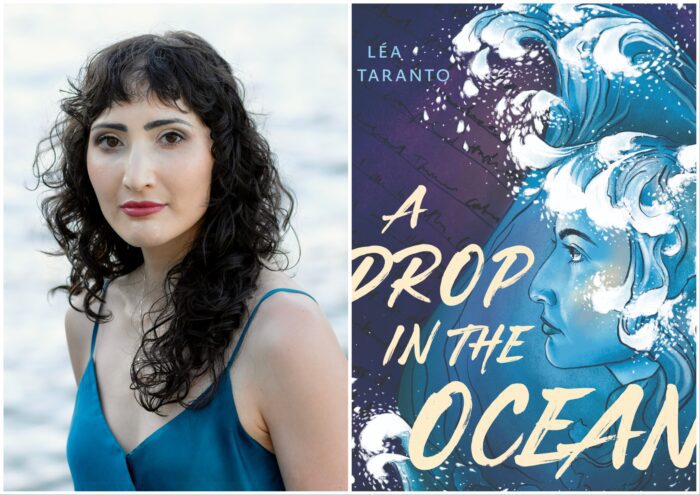
The Author Spotlight Series shines a light on writers creating heartfelt and original work across genres, giving them an opportunity to talk about their books and why they do what they do.
Click Here to follow the series as it progresses.
To submit an author for consideration, email editors@myentertainmentworld.ca.
…
“Léa Taranto is a disabled Chinese Jewish Canadian writer who lives with OCD and comorbid disorders. An MFA graduate of the University of British Columbia, alumnus of Simon Fraser University Writer’s Studio, and member of PRISM International’s poetry board, she resides on traditional, unceded Halkomelem and Squamish territories in BC.”
When did you know you wanted to be a writer?
In preschool my goal was to be a magical poet. As a mixed-genre writer with witchy inclinations, I like to think that I’m the older, broader, and maybe even wiser version of those things.
Do you remember the first thing you ever wrote?
During my magical poet goals era, I would get my mom to transcribe stories for me. Some were fan fiction based on TV shows or books and others were insert-self fairytale epics. Fan fiction and insert-self are both terms I didn’t learn until university where I also learned that these intuitive entryways into storytelling were considered lowbrow. I’m grateful to have a wider literary community these days that delights in rather than frowns upon genre.
How did you develop your skills?
The broad answer is by reading widely and writing regularly. It doesn’t have to be every day, but having a writing practice that you keep up with—even when the words aren’t flowing easily—is so worth it. What helps keep me accountable now that I’m out of school is being part of writing groups where we set dates to exchange work and comments. I also find it motivating to sprint for a few hours with friends. We chat about our projects, then write for an agreed upon time, then check in with each other.
A great craft book that breaks writing down into stages and aspects (POV, description, dialogue, the pacing of scene vs summary) is The Modern Library Writer’s Workshop by Stephen Koch. Another book that examines writing through a decolonial lens is Craft in the Real World by Matthew Salesses.
Who are some of your biggest literary influences? Do you have a favourite book/author?
There are too many amazing books and authors out there for me to choose a favourite. Some that stand out to me as particularly exceptional are N.K. Jemisin, Catherynne M. Valente and Ken Liu.
Influence wise, I admire Ruth Ozeki’s ability to encapsulate the complexity of family ties that neurodivergence can exacerbate. In A Tale for the Time Being, she strikes a brilliant balance in the diary entries of Nao Yasutani, capturing youth’s urgent intensity and awkward goofiness without feeling contrived or overdone. Mona Awad and Eden Robinson are two other nuanced but playful voice experts. I love how their novels incorporate compelling speculative elements to varying degrees.
How would you describe your work?
Regardless of genre, my writing is excruciatingly honest. I tend to favour first person POV present tense, because that bracing intimacy where we’re so close in first person to a character that we become them, and we’re immersed in scene, is the closest thing to magic I’ve ever experienced. Since I’m a sucker for that kind of empathetic resonance, I’m a fan of character-based arcs and making it as visceral as possible with concrete details that evoke all five senses. Something about that kind of specificity and vulnerability is what grips me whenever I read.
What’s your writing process like?
I like to plot out the skeleton of a story scene by scene in point form. If I know them already, I’ll jot down important details like snippets of dialogue. It takes me a frustratingly long time to draft, so I try to make small achievable goals based more along the beats of the story than on word count. Once I finally have a complete rough draft, I leave it alone for as long as I can stand (for my novel this was over a month) to get some emotional distance and objectivity from it. Then I reread it making notes on what’s effective, what’s confusing and what needs to change. I break revision into large-scale structural edits first, before sentence-to-sentence level finessing.
Tell us about your most recent book.
A Drop in the Ocean is my debut novel. It’s based on the journals I wrote from ages 13-18 institutionalized for life-threatening obsessive compulsive disorder, depression and anorexia. While fantasy novels helped me escape, journal writing was one of the only ways to have power over my own story. A writer I admire and trust who also has OCD said it was possibly the most realistic young adult novel she’s ever read. Here’s the back cover synopsis:
Sixteen-year-old Mira Durand has just been checked into the secure unit of the Residency Adolescent Treatment Centre for obsessive compulsive and comorbid disorders. Four years of being passed around different psych wards like a hot potato have only worsened her OCD and anorexia. Her brutal, religious compulsions, which she believes keep her mom safe, make her less of a clean freak and more of a freak freak. No wonder her only friend is her journal.
At the Residency’s Ward 2, Mira discovers that her shrink is a fellow fantasy nerd and that her wardmates have enough of their own high-risk behaviours to tolerate hers. The complex friendships she forms with them (including a first love), the slow trust she builds with her treatment team, and the outside and family visits she earns give her things to look forward to beyond the drudgery of her compulsions. But it takes visiting Gung Gung, her dying maternal grandfather, for her to realize that to truly live, she must fight the cognitive distortions at the heart of her compulsions.
What are you working on now/next?
I’m currently drafting a historical speculative fiction novel set in BC’s Lower Mainland from the sixties onward. It follows Chinese Canadian sisters Meising and Meiji who can dream their way into the spirit world, inhabited by beings like the storm dragons in charge of rainfall. When Meising is institutionalized for bipolar, she meets other patients with their own spirit world connections. But what can dreams do against the waking world dangers of a healthcare system convinced hurting you is for your own good?