The Author Spotlight Series shines a light on writers creating heartfelt and original work across genres, giving them an opportunity to talk about their books and why they do what they do.
Click Here to follow the series as it progresses.
To submit an author for consideration, email editors@myentertainmentworld.ca.
…
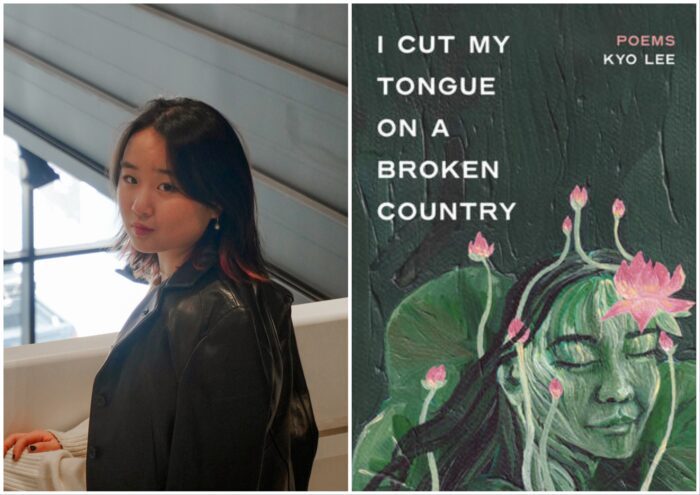
“Kyo Lee is a queer Korean Canadian high school student living in Waterloo, Ontario. She is the youngest winner of the CBC Poetry Prize and the youngest finalist for the RBC Bronwen Wallace Award. Her work has appeared in PRISM International, Nimrod, The Forge Literary Magazine, and This Magazine, among others. She loves summer storms and sweet peaches”.
When did you know you wanted to be a writer?
Eighth grade is when I realized I could become a writer. When I was younger, I had the idea that I wanted to be an author, but it seemed kind of an incomprehensible, almost fantastical, job to me—how could someone have so many words stored inside them? But in the eighth grade, I read The Outsiders by S.E. Hinton. I was absolutely mesmerized by it before realizing that Hinton was around 16 years old when she wrote the novel. That’s when it occurred to me, like a muted epiphany, that all you need to become a writer is to write.
Do you remember the first thing you ever wrote?
The first words I ever read were something like “오세훈 서울시장 강남 아줌마 사로잡기” (Seoul Mayor Oh Se-hoon Wins Over Gangnam Women), which I believe was that day’s newspaper headline. I only remember this because my parents are rather fond of this memory. I don’t remember the first thing I ever wrote. But I think I was always living inside stories, imagined by myself or someone else, before I could write.
How did you develop your skills?
People always say that practice is the only way to improve, but they don’t talk about how to continue practicing. I think I was only able to continue practicing because it didn’t feel like practicing; it felt like producing, and it felt like producing because I was getting results (i.e., winning awards, getting published). This might just be the result of my brain being result-coded as a consequence of marination in capitalism juice, but I tend to lose interest if I don’t have tangible proof of my achievements.
I was wildly lucky that I was rewarded as soon as I started writing and to have been young when I started because there are more opportunities for young people to succeed while being bad. If I hadn’t been rewarded, I might never have written again after the eighth grade.
Perhaps one way to make practicing easier is to never consider it practice. To me, practicing feels like a waste of time, even though it is never a waste of time. But writing for contests or magazine submissions or for a longer project like a book doesn’t feel like a waste of time even if it doesn’t end up anywhere. What I’m trying to say is to always practice by never practicing.
Who are some of your biggest literary influences? Do you have a favourite book/author?
Some of my favourite poets are Mary Oliver, Ocean Vuong, Ada Limón, K-Ming Chang, and Richard Siken, in no particular order. Ocean Vuong’s Night Sky with Exit Wounds had me in a chokehold for a while (I think it will always have at least a light chokehold on me); it had a significant influence on my work in and out of my book. Outside of poetry, I am frequently thinking about A Little Life by Hanya Yanagihara, even though it’s been over a year since I read it.
How would you describe your work?
It’s both loud and fragile. It makes bold statements, but it might cry if you argue with it. I think all of my poems are confessions. Some of them are prayers. They are always stories. Usually they are many stories put together. Usually they are stories I cannot tell except in written form. I kind of like to think that a lot of my work is conversational in tone, but people tend to disagree with me.
What’s your writing process like?
Usually, I write a poem in one sitting, and the next day, I edit it. I don’t edit the poem on the first draft; I find a new page and rewrite the poem. It’s like cleaning your closet—if you want to be serious about it, you can’t just take out the stuff you don’t want. You have to take everything out and put the stuff you want back inside.
Tell us about your most recent book.
I am at once satisfied, scared, and skeptical to say that this book is everything I had. It’s a collection of almost every poem I am proud of. It’s a story about growing up, growing up as a queer, racialized, female subject and the sufferings and joys that accompany these adjectives. How do we grow out of/ into/ alongside different identities? The book doesn’t know, of course, but it’s trying to.
Besides being a story of prepositions, I hope it is a story of love—love for family, friends, lovers, moments, things. It’s an attempt to simultaneously break and preserve love, to create new types of love, and to indulge in love. It’s about queer relationships in church settings; it’s about purposely disappointing your family; it’s about dead rabbits & unturned peaches.
What are you working on now/next?
I don’t know. I think it’s going to be a novel. This is the longest I’ve gone without creative writing ever since I started writing with my own will in the eighth grade. This used to bother me a lot even a couple of months ago (it still bothers me a little bit), but recently I’ve been finding comfort in the idea of “creative fermentation.” I would like to think that preparations required for writing are happening inside me even if I am not actively involved in them. Ideas need time to develop without my interference. Like I said, I feel like i cut my tongue on a broken country was everything I had. It makes sense I need to fill up with new inspirations before I can exploit them in my writing.