
The Author Spotlight Series shines a light on writers creating heartfelt and original work across genres, giving them an opportunity to talk about their books and why they do what they do.
Click Here to follow the series as it progresses.
To submit an author for consideration, email editors@myentertainmentworld.ca.
…
“Dr. OmiSoore H. Dryden, a Black queer femme, is the James R Johnston Endowed Research Chair in Black Canadian Studies, Faculty of Medicine, and interim director of Black Studies Research Institute at Dalhousie University. She is the co-founder and co-lead of the Black Health Education Collaborative and engages in interdisciplinary scholarship and research that focuses on Black LGBTQI communities, blood donation systems in Canada, anti-Black racism in healthcare, medical education and Black health curricular content development. She is the co-editor of Disrupting Queer Inclusion: Canadian Homonationalisms and the Politics of Belonging and co-author of “Time to Dismantle Systemic anti-Black Racism in Medicine in Canada.” She is an associate scientist with the Maritime SPOR SUPPORT Unit, a member of the Black Feminist Health Science Studies International Collective, a past co-president of the Black Canadian Studies Association and a founding member of the National Coalition Confronting Anti-Black Racism in Donor Protocols.”
When did you know you wanted to be a writer?
I came to this realization later in life – after I completed my PhD. I was always a voracious reader, loving the written word and in awe of those skilled at writing. Now, I hesitantly call myself a writer, I continue to struggle with the process, but am also feeling the push to share my thoughts and reflections in writing now more than ever. As a scholar and an academic I do a bunch of different styles of writing now and I think now I can call myself a writer.
Do you remember the first thing you ever wrote?
The first thing I wrote for publication was a love note for an ex. I explored what I appreciated about our relationship and why I’m glad the relationship ended. I was nervous about the intimacy of the writing, but am still so proud of that piece.
How did you develop your skills?
Reading, writing, re-writing, re-writing, and starting again. I also share my drafts with trusted colleagues who let me know what is and isn’t working, or unclear. I find sharing my drafts the most difficult thing to do and struggle with perfectionism, which has only slowed my writing progress. I keep working on this important and vital step. My skills development around writing really came into focus as I began graduate studies. A specific type of writing, but this also became an entrance into broader more diverse forms of expression.
Who are some of your biggest literary influences?
Again so many! Audre Lorde, bell hooks, Octavia Butler, Katherine McKittrick, Chandra Prescod-Weinstein, Simone Browne, Leslie Feinberg, Alexis Pauline Gumbs, M. NourbeSe Philip…
Do you have a favourite book/author?
I do! More than one! My top 3 are Parable of the Sower by Octavia Butler, Sister Outsider by Audre Lorde and Black Queer Studies: A Critical Anthology, edited by E. Patrick Johnson, Mae G. Henderson
What’s your writing process like?
[laughs] feast famine feast famine feast famine! My writing process, at times, can feel brutal, it can be very isolating. Currently, I have been responding to external deadlines which adds additional pressure. And there is a place for those external deadlines, to keep me on track and to ‘force’ me to release my work to others in the process.
In some ways my process is very traditional – outline, abstract, headings, and key discussion points. I find that stream of consciousness helps, a form of brain dump. This helps me clear some space to think through the key ideas I want to work with. Once I have a full draft, I share with a colleague to give me general comments before I begin the next draft.
Tell us about your most recent book.
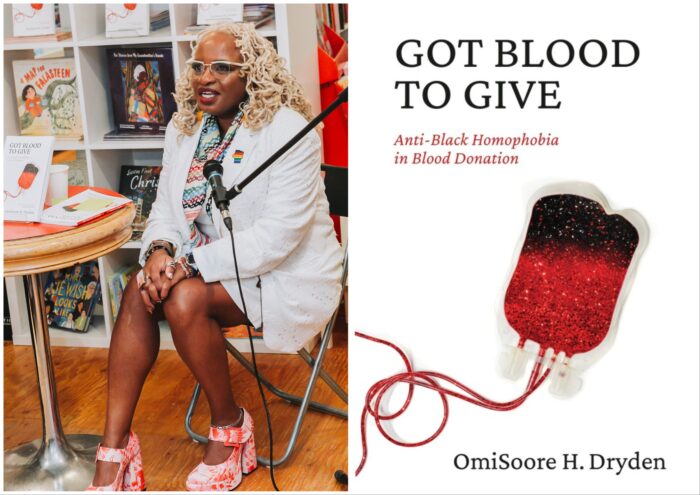
Got Blood to Give: Anti-Black Homophobia in Blood Donation is a love project, 20 years in the making. It looks at the experiences of Black queer and trans people through a Black queer and trans gaze and analyses the practices of blood donation. I focus particularly on blood donation practices from the 1940s, through the AIDS and tainted blood crisis of the 80s and 90s and first 25 years of Canadian Blood Services. Got Blood To Give exposes the historical and systemic racism and homophobia that has influenced how blood safety has been determined. I get into the weeds summarizing the research and outlining the troubling history and contemporary practices. I also begin each chapter with a blood story – personal, political and national. It is my hope that these blood stories help to further ground the information in the book. My book reflects on the stories we tell ourselves about blood and blood safety in donor protocols. I hope my book will have the reader reflecting on their own personal blood stories. It is difficult to grapple with the interlocking experiences of anti-Black racism and homophobia, and I engage with this difficult knowledge through the area of blood donation protocols.
What are you working on now/next?
In terms of blood and blood practices, I am interested in collecting more personal blood stories and connecting those stories with blood illnesses, disease, diagnostics and rituals. I’m very excited about continuing these explorations.