The Author Spotlight Series shines a light on writers creating heartfelt and original work across genres, giving them an opportunity to talk about their books and why they do what they do.
Click Here to follow the series as it progresses.
To submit an author for consideration, email editors@myentertainmentworld.ca.
…
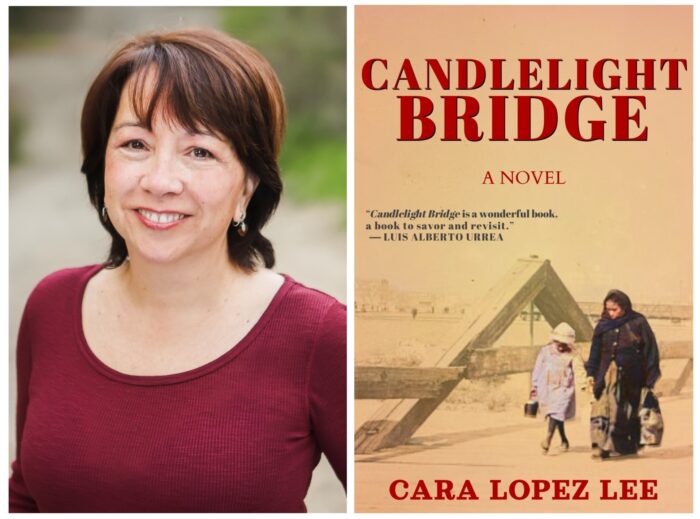
“Cara Lopez Lee is the author of the historical novel, Candlelight Bridge. She’s also the author of the memoir They Only Eat Their Husbands, and coauthor of the veteran-acclaimed Unexpected Prisoner: Memoir of a Vietnam POW (with Robert Wideman). Her writing has appeared in the Los Angeles Times, Rivet and Manifest-Station. Lee was an award-winning TV journalist in Alaska. Lee is also a winner of The Moth StorySLAM and is featured in such storytelling shows as Unheard L.A. and Risk. She’s passionate about traveling, swing dancing and binging stories of all kinds. She and her husband live in Ventura, California.”
When did you know you wanted to be a writer?
I was a lonely only child with few friends but lots of bullies, with parents who were often absent and grandparents who bought me lots of books. I often sat alone in my mother’s overstuffed armchair to read. Books were my first friends. In third grade, I read Little Women and identified with Jo, who got in trouble for speaking her mind and doing things her way. I wanted to be a writer like Jo, which is to say, like Louisa May Alcott, though it took years to believe I could write a book, which seemed like magic.
Do you remember the first thing you ever wrote?
In third grade, I won a contest with a poem about a snowflake that went on an adventure. The snowflake floated from place to place until it found a home, where it melted.
How did you develop your skills?
I studied journalism in college and began my writing career as a TV reporter. Mentors taught me to dig deep to show how news affects people, often by diving into one person’s story. So, when I moved into creative writing, I knew the importance of a personal viewpoint. Journalism also honed my research skills, which helped when I learned that “writing what we know” doesn’t mean we’ll know every detail from the start. One lesson from my TV days remains the hardest: though I have a lot to say, I strive to pare it down to only what moves the story forward. Most important, I’ve spent years honing my craft with the support of workshops and writing groups.
Who are some of your biggest literary influences? Do you have a favourite book/author?
I read all over the map, and my influences comprise a kaleidoscope. Here are a handful of my favorite authors and novels: Luis Alberto Urrea (The Hummingbird’s Daughter), Amy Tan (The Hundred Secret Senses), Kazuo Ishiguro (The Unconsoled), Michael Ondaatje (The English Patient), and Toni Morrison (Sula). A few singular books have opened my mind to the unlimited possibilities of what a story can be, such as David Mitchell’s genre-bending Cloud Atlas and the offbeat short stories of Daniel A. Olivas’ How to Date a Flying Mexican. Jane Austen is one of my perennial favorites. I’m not sure whether she has influenced my writing, but she was subversive for her time, and I only hope to be half so bold in mine.
How would you describe your work?
All my stories are about the search for home and belonging. This wasn’t a conscious choice at first but a motivation that revealed itself through decades of writing. Once I discovered this driving force, it grew easier to know which parts of a story to lean into and what to let fall away. The desire to find our place in the world is universal, so all stories contain some element of the questions I most love to explore: What is home? What is belonging? And how far might we go to find them?
What’s your writing process like?
Here are three things I’ve found important to my writing practice:
I don’t wait for inspiration. I schedule regular writing time so when inspiration strikes I’m already in the chair, ready to receive the magic. Even if I’m writing garbage, I keep going. I can always edit garbage, or hack a path through it until I find the unexpected treasures it hides.
On my first draft, I trust my subconscious, which knows better than I do the story that wants to be told.
I outline only after I finish a chapter. Rather than plan what to write, I ask questions about what I’ve just written. My answers reveal what needs work. Maybe a character’s motivations are unclear, a conflict needs higher stakes, or nothing has changed in five pages! Once I save my notes, I’m free to move on and revise later. I used to labor over every problem, spinning my wheels for days, but I’ve learned answers come faster when I move forward. Sometimes, I find out I didn’t need that frustrating chapter after all. In a first draft, momentum is key, spilling all my raw material onto the page. This has dramatically sped up my progress and improved my storytelling.
Tell us about your most recent book.
My historical novel, Candlelight Bridge, was inspired by the family stories my Mexican-Chinese grandma used to tell me: tales of secret immigrants, mixed race children, and trauma passed on like a torch from one generation to the next. All my life, people have asked me, “What are you?” This book is part of my answer. However, it is a work of imagination, with fictional characters, set in a time long ago—from 1910 to 1934.
In 1910, twelve-year-old Candelaria Rivera and her family flee to America to escape the rising storm of the Mexican Revolution. Meanwhile, twenty-year-old Yan Chi Wong flees the Chinese Revolution and a shattering loss, also bound for America, where he’s nicknamed Yankee. Two years later, they meet in El Paso, Texas, where they struggle to make a home in a world that does not want them, until a terrible desire threatens to destroy their lives. Candlelight Bridge is not a romance but a tale of unlikely partners struggling to survive the American Dream.
What are you working on now/next?
I’m now working on a sequel, which will pick up in 1934, the same year Candlelight Bridge leaves off. The sequel will follow the next generation of the Wong and Rivera families, focusing on two characters who were children at the end of the first novel. I plan to take the story to the Eastside of Los Angeles, the Chinese cities of Guangzhou and Hong Kong, and back to the borderland of El Paso. I hope to carry it all the way to the 1960s. After that, who knows?
Where can we find you online?
Official Website: CaraLopezLee.com
Facebook: /theyonlyeattheirhusbands
Instagram: @caralopezlee
Threads: @caralopezlee
TikTok: @caralopezlee