
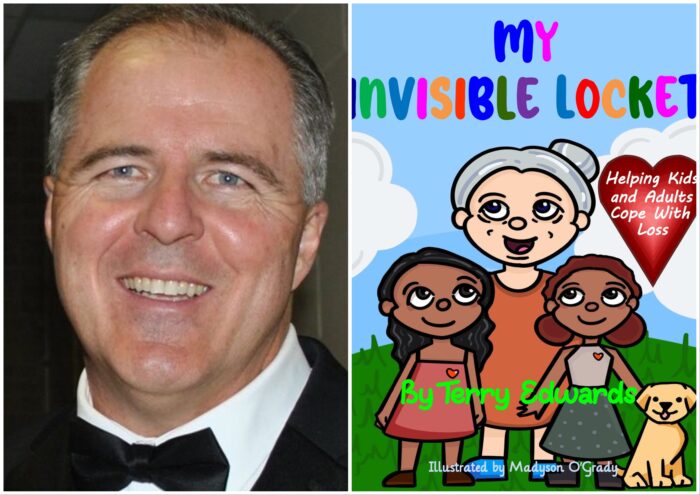
The Author Spotlight Series shines a light on writers creating heartfelt and original work across genres, giving them an opportunity to talk about their books and why they do what they do.
Click Here to follow the series as it progresses.
To submit an author for consideration, email editors@myentertainmentworld.ca.
…
“As a husband, a parent of three boys, and an educator for over thirty years, Terry Edwards has seen first-hand the tremendous impact that grief can have on a child. He believes that My Invisible Locket will benefit children in grief, and help to form stronger bonds between kids and the caring adults in their lives. Terry is a firm believer in life-long learning. When the opportunity to write his first book came in retirement, he seized it. Never say never, and always remain open to new experiences!”
When did you know you wanted to be a writer?
For as long as I can remember, I have loved to write. However, it was little more than a hobby, or a form of personal expression. In a reflection of my age, we did not have laptops in high school. All writing was done by hand, and my handwriting was horrendous. I would routinely write songs or poems for my girlfriends, and eventually, for my wife.
I believe that a love of writing begins with a love of reading. As a kid, I read anything I could get my hands on: cereal boxes, comic books, the sports page, treasures from the school book fair, etc. Of course, with no internet to explore, options were limited compared to today (there are positive and negative aspects to this).
Much to the dismay of my highschool English teachers, I was never a fan of Shakespeare. I loved the other genres that we were exposed to, and I was always open to something new. If I could redo high school English with a computer and courses like Writer’s Craft, my earlier perspective towards writing would have been far more positive.
Do you remember the first thing you ever wrote?
My dad was the manager of a local business. If he had work to do at the office at night or on weekends, I would often go with him and create poems or short stories on the office typewriter. If I wanted my parents to wake me up at a certain time, I would leave them elaborate notes, always with a comedic flair. I have always enjoyed thinking outside the box and putting my own spin on things.
How did you develop your skills?
My university undergrad had a strong left-brained focus (computer science and math). Opportunities for writing were minimal, but this changed completely during my MBA. Although the subject matter was generally business related, writing was a core aspect of the program.
In my initial career as a management consultant and my primary career as a high school teacher and administrator, effective communication was essential.
Writing a children’s book was a completely new challenge. In retirement, I serve as a supply principal, often in elementary schools. That being said, I was never an elementary school teacher and we don’t have grandkids yet. Fortunately, my wife was an amazing elementary teacher! I sought feedback on many levels throughout the writing process. Was the style engaging and appropriate for kids? Word choices were made carefully and revised often.
Who are some of your biggest literary influences? Do you have a favourite book/author?
I would not say that I have a favourite book or author. With music, what I want to listen to depends on the day, my mood, the atmosphere, etc. I find the same thing with books. As such, I will sometimes have more than one book on the go simultaneously. Overall, I love thrillers! If they are well written and engaging, I quickly reach a point where I can’t put them down.
How would you describe your work?
For my first book, a number of people commented that it had a Robert Munsch vibe (to date, I have still not made it through a reading of Love You Forever without tears streaming down my cheeks). I am certainly not going to compare myself to such an accomplished author, but the reference was greatly appreciated.
Others have mentioned that I look like a football coach, and not the author of a children’s book. Fair enough – I played and coached football for over 40 years. In response, however, I asked them what the author of a children’s book should look like? After taking some time to ponder this, most people simply smiled and retracted their question. People who know me well have commented that my book seems like a natural extension of my personality. Again, this complement was greatly appreciated.
As a retired educator writing his first book, I wanted to provide an opportunity to a high school artist who currently attends the school I retired from. I approached the school’s art teacher and described the nature of my book. I knew she had many talented artists, but I was hopeful that she would have someone particular in mind. Fortunately, she did! I met with Madyson O’Grady and gave her a preliminary draft of my book. I had inserted clipart throughout the book as placeholders. We discussed the meaning behind each piece, and the message I hoped to convey. I wanted Madyson to have the artistic freedom to choose the most effective method with which to convey this message.
What’s your writing process like?
Confession time – it was not my intention to write a book. I have always believed in lifelong learning and that we are never too old to try new experiences. Never say never. In retirement, I have maintained that mindset.
Like most people, I don’t recall most of my dreams, or they fade shortly after I wake. My first book was literally based on a dream. I awoke in the middle of the night from a vivid dream. However, every detail was still fresh in my mind.
It struck me that my dream had the potential to be a children’s book. Rather than drifting back to sleep, I jumped out of bed and hit the computer. I wanted to do a brain dump while everything was still fresh in my mind.
My writing style starts with a skeleton – hit all of the main ideas first, and see if they form a coherent and interesting path. From there, continue to add flesh to the bones, and revise, revise, revise.
Admittedly, there were times when I let things slip and put the book on hold, with too many other tasks and projects that seemed to become a higher priority. The turning point came in a moment of self reflection. Like many people, there are too many things that I have started, but never finished. I vowed that my first book would be different. Even if I never sold a single copy, I was going to see this through to completion. It was an incredibly satisfying feeling to hold the first author copy in my hands.
As an indie author, my extended family served as my preliminary editors, critics, and support group. A longtime colleague and fellow football coach recently retired after a distinguished career as an English teacher. I asked him to review my work with a critical eye. He knew that I have a thick skin and I knew that he would tell me what I needed to hear, not what I wanted to hear. This led to major revisions, many minor changes, and a superior book in the end.
Tell us about your most recent book.
Throughout our lifetime, we will experience loss and a sense of grief. While this can be overwhelming for anyone, it can be particularly difficult for children. Whether it relates to the death of a loved one, the loss of a pet, dealing with a serious illness, a friend moving away, a military parent on deployment, or other difficult circumstances, children need our support.
Children are naturally inquisitive, but that doesn’t mean that they are always willing to talk, particularly when the subject matter is difficult or potentially painful. How do we start the conversation and keep it going?
My Invisible Locket is an illustrated children’s book designed to initiate and direct conversations between caring adults and children, on the topic of grief and/or loss. It sends a message to children that it is natural to experience grief, but it is important to talk about it, rather than keeping their emotions bottled up inside.
What are you working on now/next?
I have had the opportunity to visit classrooms, read my book to the class, and help them build their invisible locket. I have found that most kids have experienced loss in one form or another. In a classroom setting, they are generally eager to share their experiences. They find comfort in knowing that their friends and classmates have experienced many of the same challenges that they have.
In other classrooms, the teacher had read the book with the class and helped them to build their invisible lockets. I came in after the fact for a Q & A session, with questions that the kids had prepared in advance. They asked very interesting and thoughtful questions, with far more spontaneous questions that emerged as our discussion progressed. Spending time with kids in these settings makes for a great day!
Many have asked if there will be a follow up to My Invisible Locket. A number of intriguing topics have been suggested, but nothing is formally in the works at this point. However, never say never!